By Richie Griffin · May 28, 2026 · 4 min read
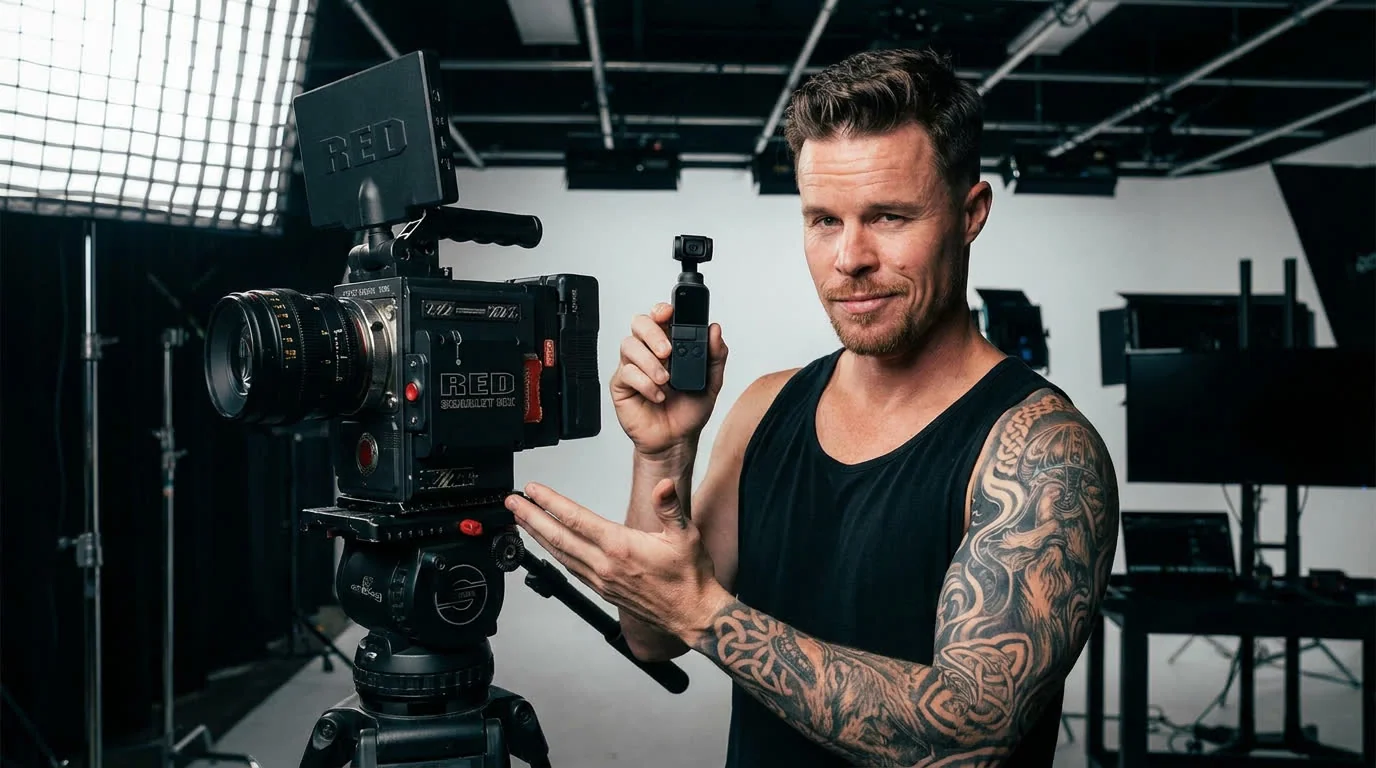
The $30K camera was a RED Scarlet-W. Cinema-grade body, real RAW codec, the whole "you've made it" feeling that comes with shooting on a RED. It ran on jobs that needed it. It also collected dust on a lot of jobs where the $30K of capability was a complete mismatch for what the deliverable actually needed.
The arc since then is the actual story: traded the Scarlet for a Canon C200 + C300 Mark II pairing. Then sold down to the Canon C70 — same Super 35 sensor, half the form factor, half the rigging headache. Then to the Canon R5C, which is where I stay. The C300 is still around for the rare job that asks for it. Less than 15% of the calendar.
That arc — bigger to smaller, more specialized to more flexible — isn't a downgrade. It's a working producer figuring out which capabilities actually pay rent in 2026 and which were status purchases dressed up as production decisions.
The mistake isn't owning the expensive camera. The mistake is reaching for it on every job — which is what most working producers were trained to do, because for years "more camera" was a real proxy for "better work." That proxy stopped being reliable somewhere around 2022. By 2025 it was actively wrong. By 2026 it's a tell that a producer hasn't updated their workflow.
Three things, in roughly this order:
The main rig — most of the paid work: Canon R5C with the Sigma 18-35 / 50-100 cinema-feel kit, Canon RF 28-105 f/2.8 for documentary, Sony A7S II as a B-cam or for low-light situations the R5C doesn't love. This body has been the home base since I stopped chasing dedicated cinema. Ships cinema-quality codecs in a stills-camera form factor that doesn't intimidate talent.
The C300 still around: earns its place when broadcast spec or a client's deck specifically calls for the Super 35 cinema look. Maybe 15% of the calendar.
The DJI Osmo Pocket 3: not the workhorse — the utility cam. Mount it in a car for an interior driving shot. Use it as a webcam for client calls. Throw it on a dashboard during a property tour where any larger camera would get in the way. The "I need a camera in a place a camera shouldn't go" tool. Doesn't replace the R5C; complements it.
Action / first-person / unconventional angles: Insta360 GO 3S, Insta360 X4, DJI Action 4, the Ray-Ban Meta glasses for true POV. None of these existed as production tools five years ago. All of them earn their place now for specific shot types the main rig can't get.
The rare jobs that justify a full cinema rig: theatrical-bound, broadcast-bound, or client-spec'd. Then yes — full pro cinema body, dedicated cinema lenses, monitor chain, the whole thing. The kit gets pulled out of the dust for those.
"Right tool for the job" is the most overused, least understood phrase in this industry. People nod at it and then spec a job for the most expensive thing they own.
The actual translation: match the camera to the deliverable, the timeline, and the working environment. A Pocket 3 in your hand on the day a property opens beats a C300 sitting in a Pelican case in your trunk because you didn't want to risk it in dust. Same logic for action cams in tight spaces. Same logic for an FX-class camera when the job actually calls for it.
Working producers who learn this earlier in their career compound faster. The ones who don't are still trying to justify the $30K camera at every kickoff, and the clients are quietly hiring someone who'll bring the right rig instead of the most expensive one.
"The camera you use is the most important camera to own. The expensive one you don't reach for — because it's too risky, too heavy, too inconvenient to deploy — is decoration."
None of this means the cinema rig is obsolete. It means the cinema rig is one tool among several. When the job is broadcast spec'd, on a controlled set, with a real budget for the equipment line — yes, the FX or Alexa or RED earns its place. When the job is "we open Saturday and need content live by Sunday morning" — the Pocket 3 wins, every time, by a margin that doesn't even feel close.
The Scarlet-W taught me to shoot. The R5C taught me to ship. Both lessons matter. Most producers stop at the first one.
Written by Richie Griffin — Las Vegas video producer, voiceover artist, and on-camera host. Founder of Richie Griffin DigiCo. Make Boring Illegal.