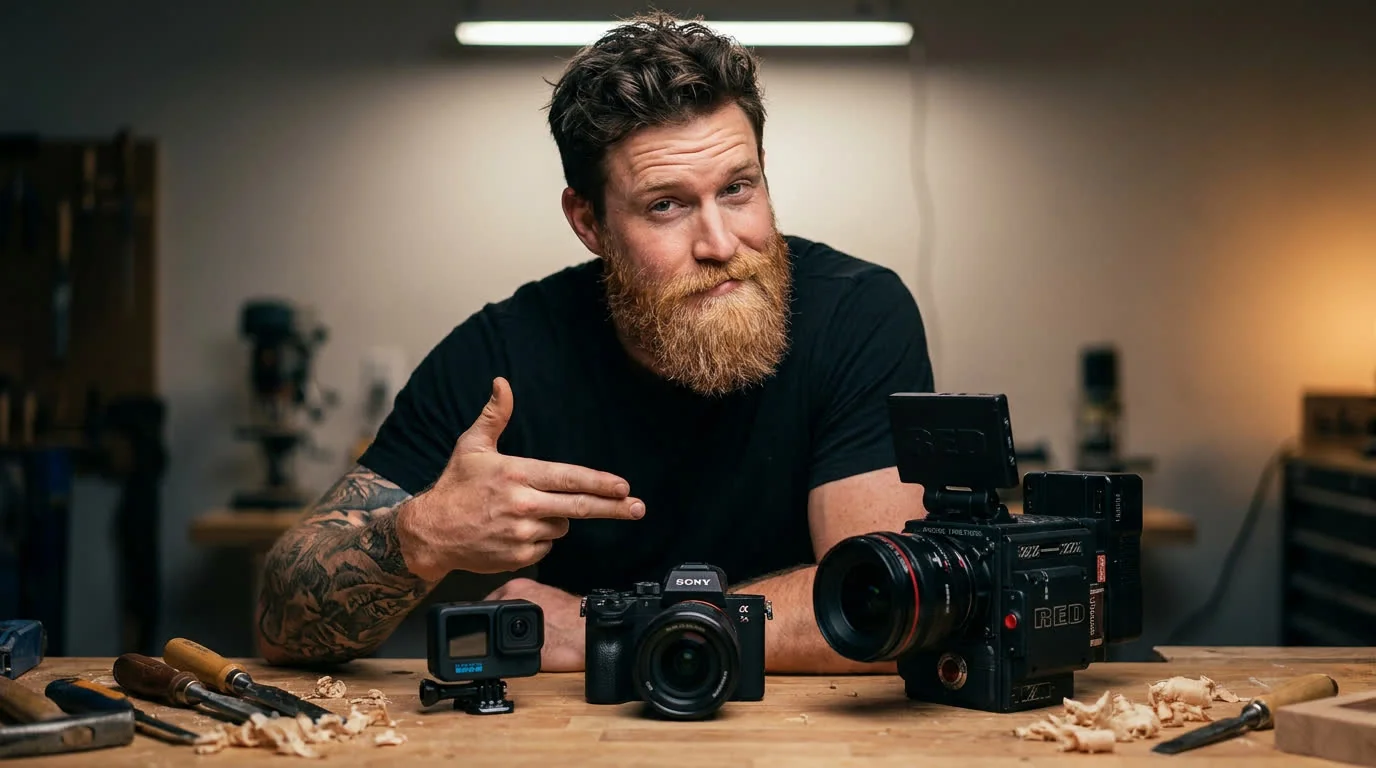
The Camera Market Has Split Into Three Categories
What that means for working producers
What that means for working producers
By Richie Griffin · May 19, 2026 · 4 min read
Five years ago, the working video producer's buying decision was effectively one variable: how much budget do I have, and which mirrorless / cinema body do I get for that budget. The market had a clean ladder: prosumer DSLR, hybrid mirrorless, dedicated cinema body. Pick your rung, climb when the budget lets you, the picture quality scales roughly with the price.
That ladder is gone. The market has split into three independent categories, each with its own use case, its own buying logic, and its own pace of change. Producers who still buy as if the old ladder exists are spending money on the wrong axis.
The category that didn't exist as professional gear five years ago and now dominates 60–70% of paid client output. The DJI Osmo Pocket 3 is the headline product, but the lane is broader — Insta360 X4 / GO 3S, DJI Action 4, the Ray-Ban Meta capture glasses, iPhone Pro with the right ProRes pipeline. All of these capture broadcast-acceptable 4K with image stabilization that used to require a gimbal and a steady operator.
What this category is for: social-first content, behind-the-scenes capture, run-and-gun documentary, action and POV shots, scenarios where any larger camera is a liability — tight spaces, dust, fast movement, talent who freezes when a "real" camera comes out.
Buying logic: these depreciate fast and improve fast. Don't buy three at once; buy one, replace it every 18 months, stay current. The price-per-capability has been falling so quickly that yesterday's model is meaningfully behind today's, and tomorrow's will outclass both.
The current center of gravity for paid commercial production. Canon R5C, Sony FX3 / FX6, Sony A7S series, Panasonic GH7. These bodies will shoot true cinema-grade 4K and 6K codecs, run real cinema lenses, monitor to broadcast spec, and handle 90% of professional commercial work without anyone questioning the picture.
What this category is for: commercial spots, brand video, sports highlights, music videos, narrative shorts, anything that needs real glass and a real codec but doesn't justify a dedicated cinema body. Most pro work in this lane.
Buying logic: this is where the money goes. A solid mirrorless workhorse plus 3–5 high-quality lenses (the Sigma Art primes still hold up; the Canon RF 28-105 f/2.8 is a documentary cheat code; pair with one or two faster Canon EF Ls for portrait/cinema reach) will out-deliver a $30K cinema body that's used wrong by an order of magnitude. Lenses depreciate slower than bodies — buy the lenses for life and replace bodies every 5–7 years.
RED Komodo / V-Raptor, Arri Alexa Mini / 35, Sony Venice 2, Canon C500 II, Blackmagic URSA Cine. The lane that still earns its place — but on a much narrower set of jobs than working producers were trained to assume.
What this category is for: theatrical, broadcast network spec, agency work where the camera is a line item the client wants to see, anamorphic projects, anything finishing on a screen big enough that the codec and sensor differences matter to the audience. Real cinema work, not "cinema-flavored" hybrid work.
Buying logic: rent, don't buy, unless the volume of cinema-spec work in the calendar genuinely supports owning a body that costs five figures and sits idle 80% of the time. Rental houses in major cities (yes, including Las Vegas) keep the latest bodies, and the rental cost on the rare cinema job is almost always smaller than the depreciation on owning one.
Three trends, all reinforcing each other:
For a working producer planning a kit in 2026:
The producers who internalized this last year are running profitable kits at half the capital outlay of competitors who are still chasing cinema-tier purchases. The producers who don't internalize it spend the next decade explaining to clients why their $30K body justifies the bid — to clients who increasingly do not care.
Right tool for the job, right kit for the calendar. Same lesson as always; new market shape.
Written by Richie Griffin — Las Vegas video producer, voiceover artist, and on-camera host. Founder of Richie Griffin DigiCo. Make Boring Illegal.